FuelCardInfo.com Methodology
How FuelCardInfo.com researches, sources and labels truck fuel card profile information, guide content and glossary definitions.
Sources Used
We rely on publicly accessible sources including:
- Provider pricing and fee pages on provider websites
- Official provider support documentation and help centers
- EIA (U.S. Energy Information Administration) diesel data for price references
- FMCSA and government publications for regulatory context
- Public PDFs, rate cards and program guides published by providers
- IFTA and IRP administrative documentation from state revenue agencies
We do not rely on aggregator sites, anonymous forum posts or user-generated reviews as primary sources for factual claims about fees or program terms.
Source Hierarchy
Provider-owned pages and documents are used first for provider-specific claims because they are closest to the current program terms. Government and administrative sources are used for regulatory context, IFTA recordkeeping and public agency definitions. App store listings, public support pages and help-center articles may support workflow claims such as app availability, reporting features or card-control settings.
When two sources conflict, the more current and more specific source is preferred. A current pricing page is stronger than an older general marketing page. A product-specific support page is stronger than a broad brand page when the field being checked is a product feature.
Profile Field Rules
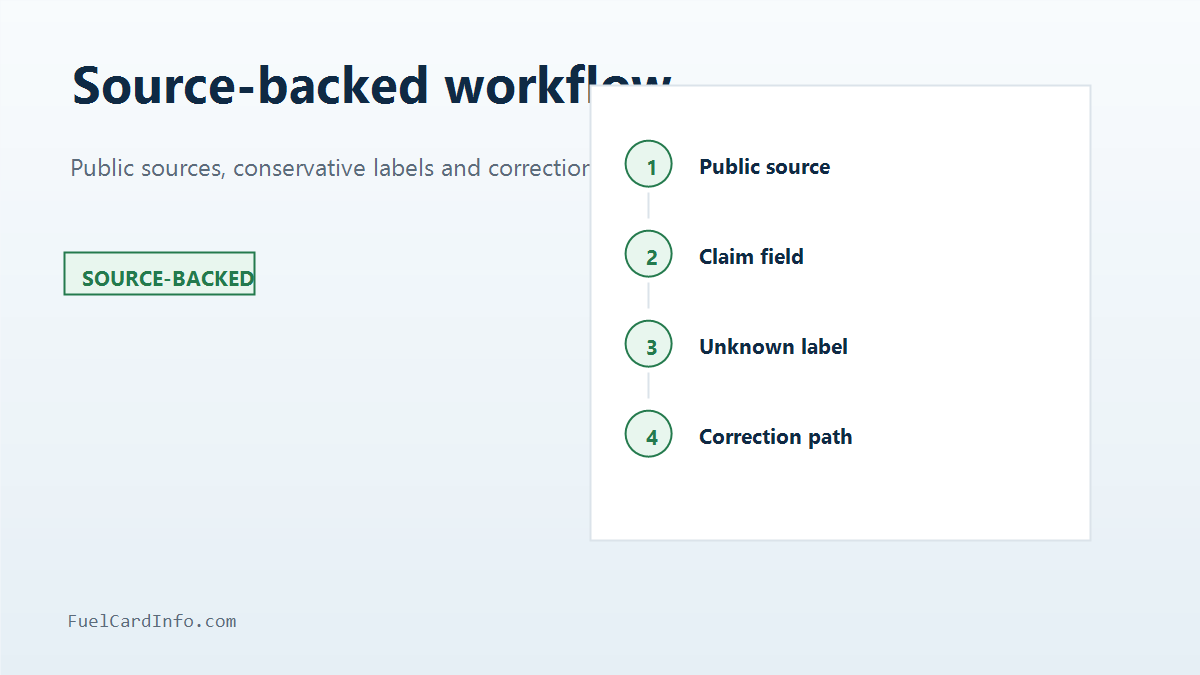
Each fuel card profile separates its fields into three categories:
- Source-backed — The value is drawn from a specific public document linked in the profile's source list.
- "Not clearly published" — A current authoritative source for this field was not found. The field is labeled rather than estimated.
- "Check with provider" — The field likely varies by applicant, fleet size, credit profile or negotiation. Examples include discount rates and approval requirements.
We do not fill in fees, rates or network coverage with estimates or industry averages when a public source is not available.
Profile Review Workflow
Each profile starts with the official provider page and then checks for pricing pages, product pages, support pages, public PDFs and app references. Fields are entered only when the source supports the claim being made. If a provider publishes general card-control language but does not identify every available setting, the profile uses conservative wording instead of expanding the claim.
The source list at the bottom of a profile is part of the content, not a decorative citation block. Readers should be able to see which public documents were used and which profile fields still require direct confirmation before applying.
What We Do Not Do
- We do not personally test every card or conduct field trials.
- We do not claim CDL, fleet-management, financial-advisor or legal credentials.
- We do not publish scored provider rankings, fabricated feedback or paid ranking positions.
- We do not treat social media posts, forum threads or third-party comparison sites as authoritative sources for provider terms.
Guide and Glossary Content
Guides explain terminology, fee structures, discount models and trucking workflows using plain language. Where a guide references a specific provider feature (for example, which cards offer IFTA reports), those claims are tied to source-backed profile data. General explanations of industry terms (for example, what "cost-plus pricing" means) do not require per-provider sourcing but should be consistent with how providers use those terms in their own documentation.
Glossary definitions reflect how terms are used in fuel card provider documentation and IFTA administrative guidance. Where a term has a precise regulatory meaning (for example, "qualified fuel" in IFTA), we note the regulatory context.
How Examples Are Handled
Examples in guides, glossary pages and calculators use simplified numbers to show the structure of a comparison. They are not provider quotes and should not be read as expected savings. The examples are meant to help readers ask better questions about fees, gallons, payment timing, routes, reports and controls.
Update Cadence
Profile pages show a last-checked date. We revisit profiles when a provider announces fee changes, network changes or program updates. We do not continuously monitor all providers in real time — fee schedules may have changed since the last check date. Readers who identify outdated fields can submit corrections; see our Corrections page.
Corrections
Corrections from providers, readers or fleet operators are reviewed against the public source cited. If a more current public source supersedes the existing source, the field is updated and the source record is revised. See our Corrections page for how to submit.